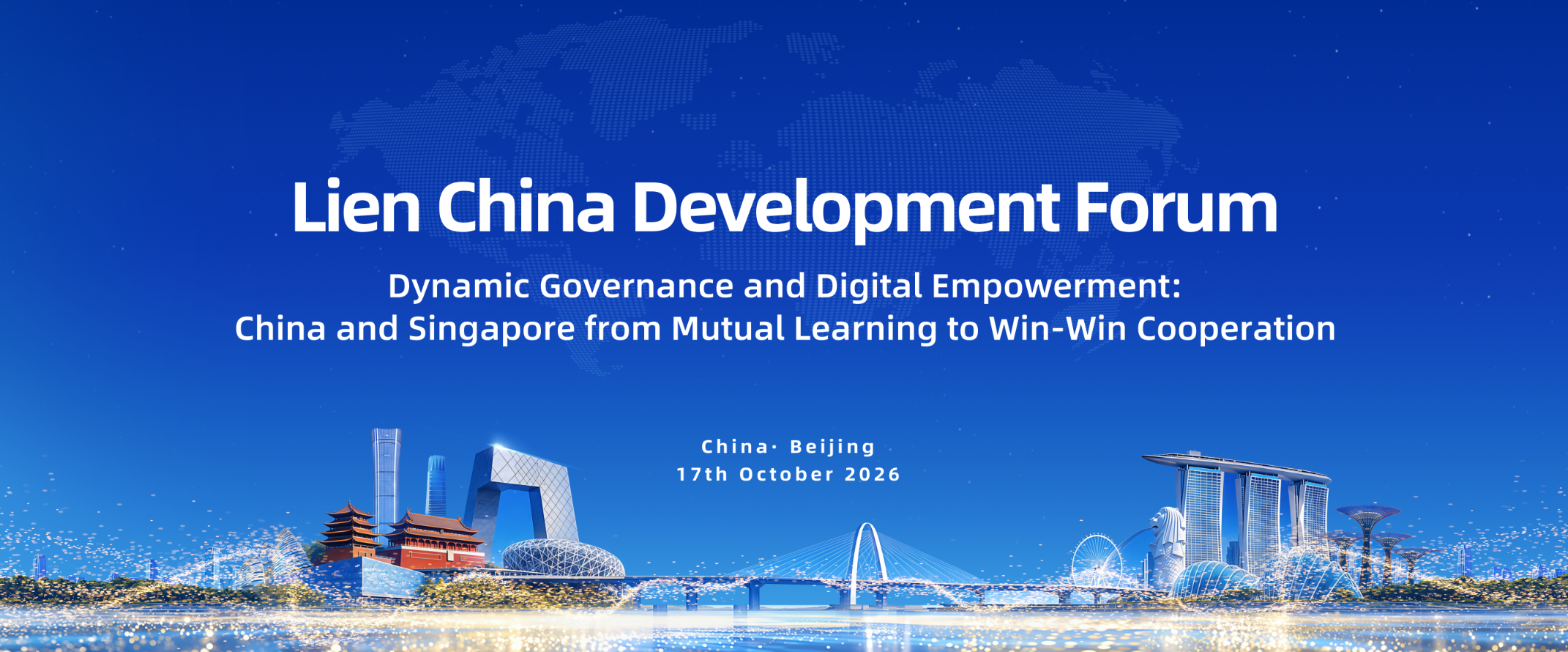

Date & Time:17th October 2026 (Saturday)
Location:Kerry Hotel, Beijing

Today’s world is undergoing profound changes unseen in a century, while the global governance system faces the dual challenges of growing complexity and uncertainty. On one hand, the rapid advancement of technological revolutions and industrial transformation has made digitalization and intelligent technologies key forces in reshaping the allocation of global resources and restructuring economic systems. On the other hand, transnational issues such as public health crises, climate change, and supply chain security are occurring with increasing frequency, placing unprecedented demands on the agility and adaptability of government governance.
Against this backdrop, “dynamic governance” — a philosophy of public administration that emphasizes continuous learning, anticipatory experimentation, and rapid feedback — is evolving from a theoretical framework into a core governing practice. Since its founding, Singapore has earned global recognition for its governance wisdom of “never ceasing to reinvent itself,” successfully balancing efficiency and equity, as well as stability and innovation through dynamic governance. Meanwhile, China, leveraging the advantages of its vast market and massive data resources, has demonstrated remarkable capabilities in scenario-based innovation and rapid systemic iteration through practices such as “Digital Government,” “Integrated Governance Platforms,” and “City Brain” initiatives driven by digital and intelligent technologies.
China and Singapore — one an explorer of modernization and governance on the scale of a major nation, the other a globally leading model of a “Smart Nation” — have, over the past decades, engaged in extensive mutual learning and cooperation through flagship platforms such as the Suzhou Industrial Park and the China-Singapore (Chongqing) Demonstration Initiative on Strategic Connectivity. However, in the face of the new challenges brought by the digital and intelligent era, the simple transplantation of experiences is no longer sufficient.
Under the theme “Dynamic Governance and Digital-Intelligence Driven Development — China and Singapore: From Mutual Learning to Win-Win Collaboration,” this forum aims to elevate bilateral relations from one-way “benchmark learning” to two-way “co-creation and symbiotic development.” The forum will explore in depth: How can artificial intelligence, big data, digital twins, and other digital-intelligence technologies empower governance systems with dynamic capabilities of “perception, response, and evolution”? How can the complementary strengths of China and Singapore in policy experimentation, data governance, and cross-border regulatory frameworks be transformed into practical and sustainable mechanisms for collaboration?
Through this high-level dialogue, we hope to build a future-oriented “community for governance innovation” that transcends bilateral cooperation and contributes a distinctive “China-Singapore solution” to the transformation of public governance in the digital era.